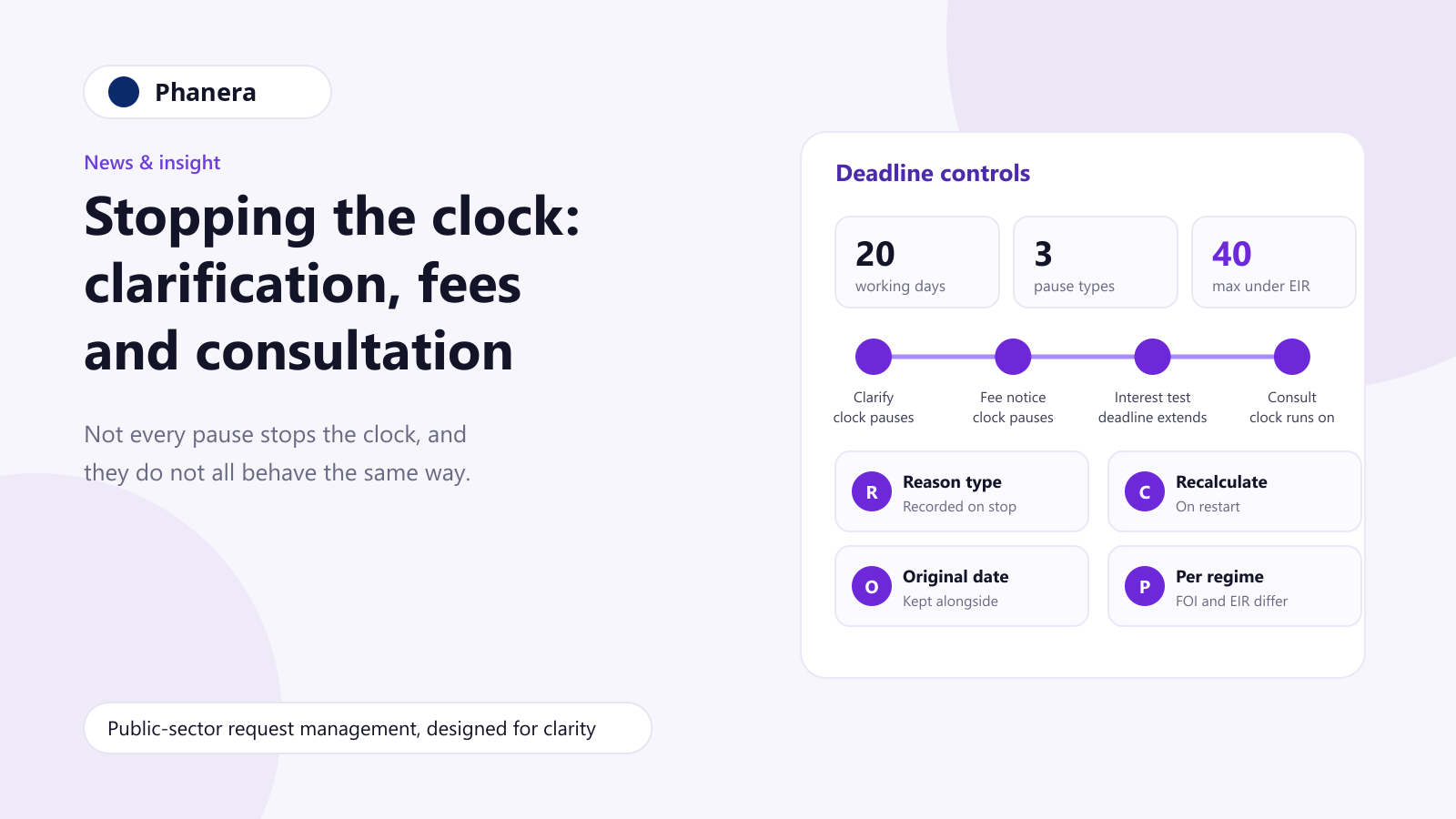
A request under the Freedom of Information Act must be answered promptly and in any event within 20 working days. Several things can legitimately affect that period, but they do not all work the same way, and teams that treat them as one generic "on hold" state usually end up with a deadline they cannot justify.
Clarification pauses the clock
Where an authority reasonably requires further information to identify and locate what is being asked for, section 1(3) means it need not comply until that information has been supplied. In effect the clock pauses from the point clarification is sought until a reasonable response is received.
Two practical cautions. The request for clarification has to be genuinely necessary, not a way of buying time on a request that is simply broad. And if the applicant never responds, the case does not stay open indefinitely. Most authorities set an internal period after which it is closed, and record why.
A fee notice pauses it differently
Where a fee is charged under section 9, the period between issuing the fees notice and receiving payment does not count towards the 20 working days. The applicant has three months from the notice to pay, and if they do not, the authority is not obliged to comply.
This is a different mechanism to clarification, with a different trigger and a different endpoint, and it needs recording as such, including the amount, the date the notice was issued, and the date payment was received.
The public interest test extends, it does not pause
Where a qualified exemption applies and the authority needs longer to weigh the public interest, section 10(3) permits an extension to such time as is reasonable in the circumstances. The Information Commissioner's guidance is that this should not normally exceed a further 20 working days.
This is an extension of the deadline rather than a suspension of the clock, and the applicant must be told which exemption is engaged and when a decision is expected. Recording the original deadline alongside the extended one keeps the distinction clear afterwards.
How Phanera helps
Phanera handles each of these as a distinct action with its own reason and dates. Clock stops record why they were applied and recalculate the deadline on restart, fee notices carry their own amounts and dates, and extensions preserve the original deadline alongside the new one, all written to the request timeline.
Third-party consultation does not stop anything
Consulting a third party whose interests are affected is good practice, and the section 45 Code of Practice addresses when it is appropriate. It does not extend the statutory deadline. The 20 working days continue to run while you wait for a reply.
That makes it worth tracking consultations with their own internal target dates, so a slow third party is visible as a risk to the statutory deadline rather than being mistaken for a valid pause.
The EIRs work differently again
Environmental information requests also carry 20 working days, but regulation 7 allows an extension to 40 working days where a request is complex and voluminous. There is no equivalent of the section 12 cost refusal; the comparable provision is the manifestly unreasonable exception in regulation 12(4)(b).
If your system applies FOI logic to EIR cases, those differences get lost. Configuring each regime with its own deadline rules is what keeps the arithmetic honest.
Record the reason, not just the pause
The common failure mode is a case that shows it was paused for eleven working days with no record of why. At review, that is indistinguishable from a delay.
Capturing the reason type, the dates either side, and who applied it turns a gap in the timeline into a documented decision. That is the difference between a defensible deadline and one you have to apologise for.