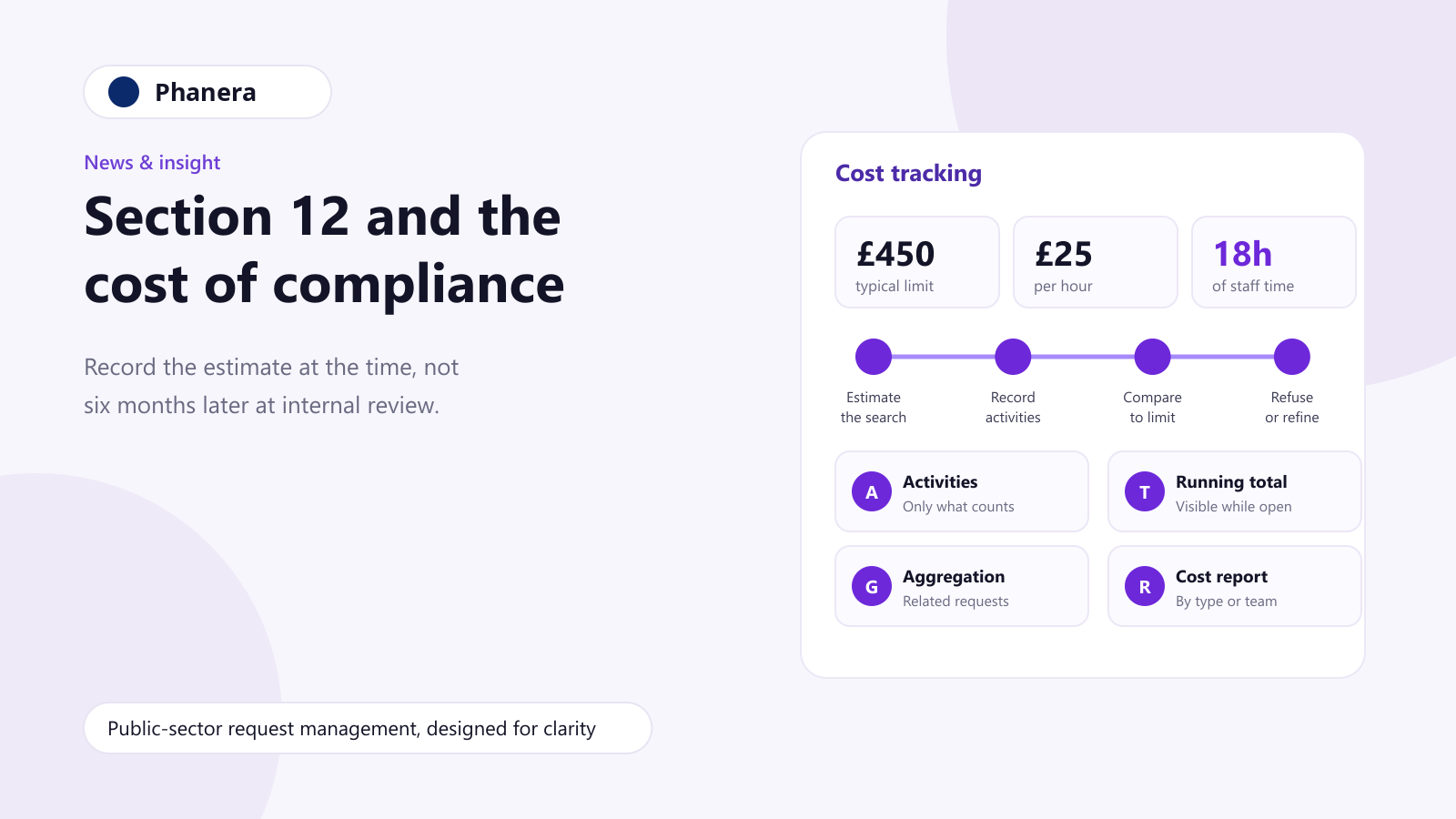
Section 12 of the Freedom of Information Act allows a public authority to refuse a request where the cost of compliance would exceed the appropriate limit. The limit is set by the Freedom of Information and Data Protection (Appropriate Limit and Fees) Regulations 2004: £600 for central government departments and certain other bodies, and £450 for all other public authorities, calculated at a flat rate of £25 per hour of staff time.
Those figures translate to roughly 24 hours of work at the higher limit and 18 at the lower one. The arithmetic is simple. The difficulty is evidential.
Only certain activities count
The regulations are specific about what may be included in the estimate. Broadly, an authority may count the time spent determining whether it holds the information, locating it, retrieving it, and extracting it from other material.
Time spent on activities outside that list does not count towards the limit. That includes, notably, the time taken to consider exemptions or to redact material. That distinction matters, because it is a common reason a section 12 refusal does not survive review.
- Determining whether the information is held.
- Locating the information or a document containing it.
- Retrieving the information or the document.
- Extracting the information from a document containing it.
An estimate still has to be reasonable
Section 12 relies on an estimate rather than a completed exercise. An authority is not expected to do the work in order to prove the work would be too expensive. But the estimate must be reasonable, and if it is challenged the authority needs to be able to describe how it was reached.
In practice that means recording the basis at the time: which systems would need to be searched, roughly how many records are involved, what a sampled search produced, and who formed the estimate. Reconstructing that six months later from memory is difficult and rarely convincing.
How Phanera helps
Phanera tracks cost activities against the request as they are recorded, applies your configured appropriate limit and hourly rate, and keeps the running total visible while the case is open. The same data feeds a cost report you can filter by request type, category or department.
Aggregation and advice and assistance
Related requests from the same person, or from people appearing to act together, can in some circumstances be aggregated when applying the limit. Where they are, the reasoning for treating them together should be recorded alongside the estimate itself.
Section 16 also continues to apply. Where a request would exceed the limit, an authority should ordinarily advise the applicant on how it might be refined to bring it within scope, for example by narrowing a date range or a set of services. A section 12 refusal that offers no route forward is more likely to come back as a complaint.
The estimate is management information too
Recorded consistently, cost data stops being purely defensive. It shows which subject areas are expensive to answer, which systems are slow to search, and where proactive publication would remove repeated effort.
That is a stronger argument for investment than an anecdote about a difficult request, and it is generally the same evidence you would need if the refusal were challenged.