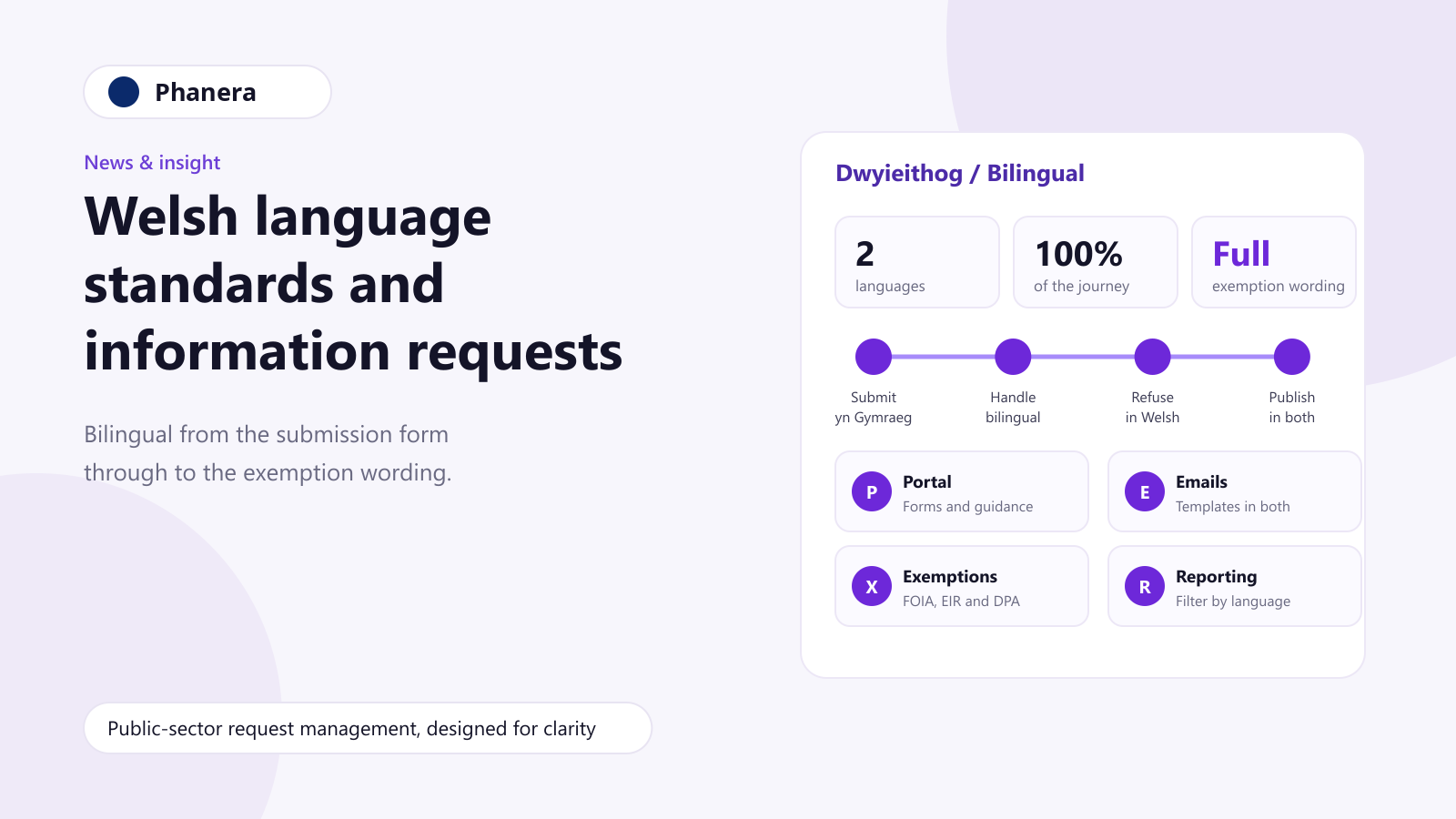
Organisations subject to standards made under the Welsh Language (Wales) Measure 2011 have duties about how they offer and deliver services in Welsh. In practice that includes correspondence: if someone contacts you in Welsh, they should be able to receive a reply in Welsh, and they should not be disadvantaged for choosing to.
Information rights work sits squarely inside that. A request is correspondence, an acknowledgement is correspondence, and a response, including a refusal, is correspondence.
Bilingual is more than a translated interface
It is common for a system to offer a language toggle on the public-facing pages and stop there. That covers the first minute of the interaction and none of the rest of it. A request submitted in Welsh then flows into an English-only case system, gets handled in English, and produces an English response.
Delivering the duty properly means the language choice has to travel with the case, not just decorate the form.
- The submission form and its guidance text.
- The automatic acknowledgement and any reference number correspondence.
- Status pages and the public disclosure log.
- Deadline and update notifications sent to the requester.
- The response itself, including refusal wording.
- The exemption or exception being cited in a refusal.
Exemption wording is the part usually missed
A refusal notice has to say which provision is relied on and why. If the system holds that wording only in English, then either someone translates it by hand for every refusal, inconsistently and under time pressure, or the applicant receives part of their response in a language they did not choose.
Holding the statutory exemption library bilingually removes that step. The officer selects the exemption once and the correct wording is available in whichever language the case is being handled in.
How Phanera helps
Phanera is bilingual across the whole application: public portal, request forms, staff interface, email templates, and the statutory exemption libraries for FOIA, the EIRs and the Data Protection Act. Each request records the language it arrived in, so replies go back in the right one.
Record the language on the case
The simplest safeguard is to store the language as a property of the request rather than as a session setting on whoever happens to be looking at it. An officer picking up a case three weeks later then knows, without having to infer it from the original text, which language the reply should be in.
It also makes the duty reportable. If you can filter by language, you can answer questions about how many Welsh-language requests you received and whether they were answered as promptly as English-language ones. That is the kind of evidence that matters when demonstrating compliance.
Branding and terminology travel too
Organisations often maintain distinct Welsh forms of their own name, service names and contact details. Those need to appear on the Welsh version of a portal and in Welsh-language emails, not just a translated shell around English branding.
Getting this right is unglamorous work, but it is visible to the people it affects. A form that switches to Welsh and then sends an English acknowledgement is more noticeable than one that was never bilingual to begin with.