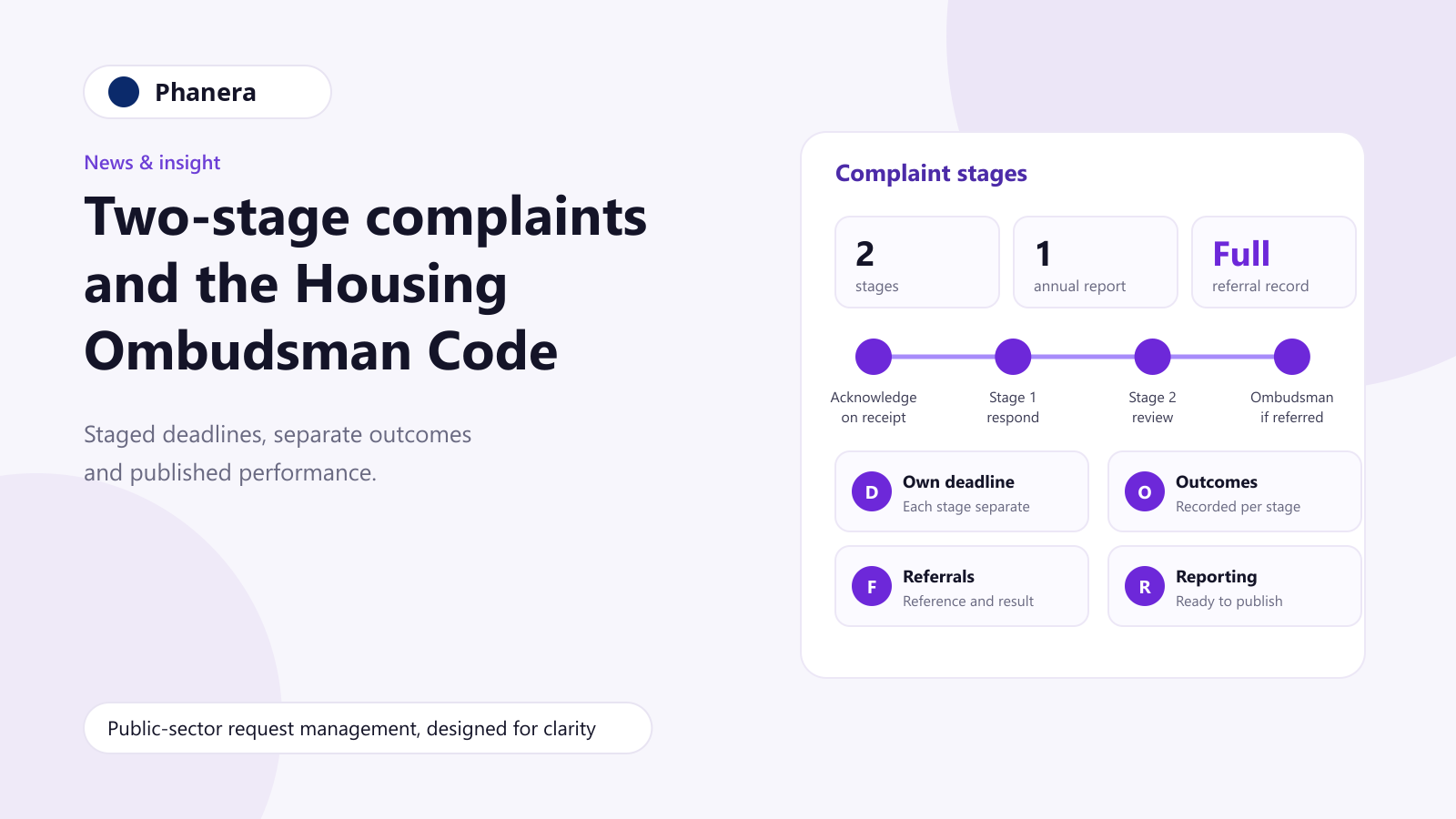
The Housing Ombudsman's Complaint Handling Code sets out how member landlords must handle complaints. Following the Social Housing (Regulation) Act 2023 it carries statutory force, and landlords are expected to self-assess against it and publish an annual complaints performance and service improvement report.
For landlords used to treating complaints as correspondence to be answered, that is a meaningful change. The Code describes a process with defined stages, defined timescales and evidence requirements. That is the shape of a case management problem.
The timescales are specific
The Code sets out working-day deadlines at each stage, with acknowledgement and response periods for stage one and a further period for stage two where a complaint is escalated. Extensions are permitted in defined circumstances, but they must be explained to the resident rather than simply taken.
- Acknowledge a complaint within the period set by the Code.
- Respond at stage one within the stated number of working days.
- Respond at stage two within the stated period after escalation.
- Explain any extension to the resident, with reasons.
- Record the outcome at each stage separately.
Landlords should work from the current text of the Code for the exact figures, since they have been revised. The structural point holds regardless: each stage is its own clock, and the second does not begin until escalation.
Stage two is not a continuation
A common weakness is treating escalation as the same case simply carrying on. It is a distinct stage with its own deadline, its own reviewer, and its own outcome. The Ombudsman will look at whether the second stage was a genuine review rather than a restatement of the first.
Recording stage one and stage two outcomes separately is what makes that demonstrable. It is also what makes the annual report possible without a manual reconstruction exercise.
How Phanera helps
Phanera handles staged complaints as a first-class regime: separate stage one and stage two deadlines, escalation between them, distinct outcomes recorded at each stage, and ombudsman referral logging with reference number and result, all reportable without assembling it by hand.
Referrals need their own record
Where a resident takes a complaint to the Ombudsman, the landlord needs to track the referral, its reference, and its outcome, including any orders or recommendations made. That record is separate from the complaint itself and tends to outlive it.
Keeping it attached to the original case, rather than in a separate log maintained by one person, is what allows the landlord to answer questions about patterns rather than individual files.
Reporting is the point, not a by-product
Because performance is now published, complaint data has an external audience. Volumes by stage, response times against the Code's deadlines, upheld rates and the categories generating repeat complaints all become figures someone outside the organisation will read.
That is far easier when the underlying data was captured as structured case information from the start. Landlords who record complaints as emails in a shared mailbox generally discover the difficulty at the point the report is due.
Complaints and subject access overlap
Residents in a dispute frequently make a subject access request alongside the complaint, particularly in disrepair and anti-social behaviour cases. The two are handled under different regimes with different deadlines, but they concern the same person and often the same records.
Handling both in one system means the team can see that the same resident has an open complaint and an open information request, which is difficult to spot when the two live in different places.