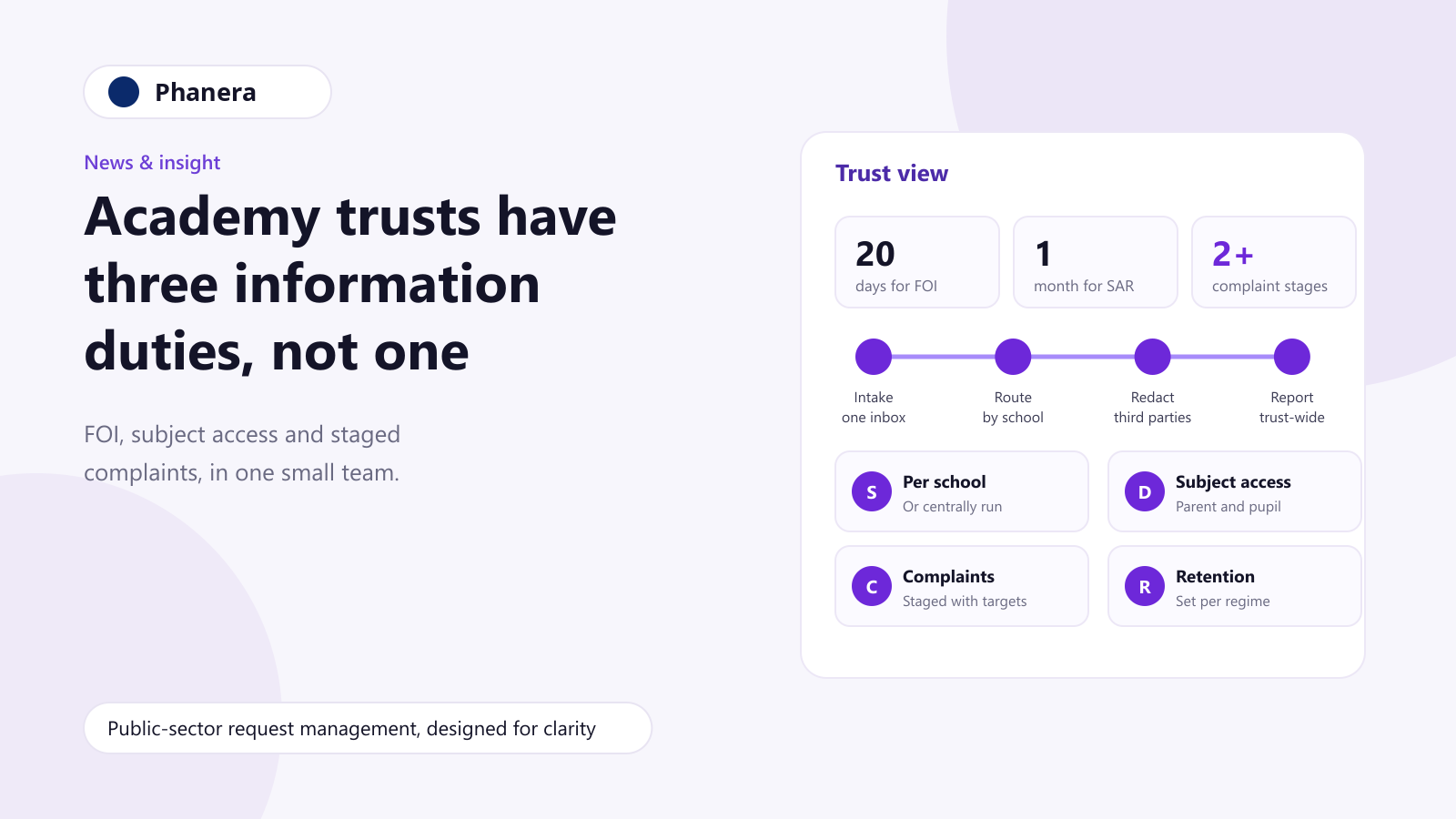
Academy trusts are public authorities for the purposes of the Freedom of Information Act. That surprises people outside the sector and nobody inside it, but the practical consequence is often underestimated, because FOI is only one of three separate obligations a trust carries.
Three regimes, three clocks
A trust of any size will routinely handle all of the following, usually through the same small central team.
- Freedom of information requests, answerable within 20 working days.
- Subject access requests from parents, pupils and staff, answerable within one month under the UK GDPR and extendable by up to two further months where complex or numerous.
- Complaints under the trust's published procedure, typically staged and each stage with its own target.
These have different deadlines, different exemptions, different record-keeping expectations and different audiences. Running them together in one spreadsheet is workable at low volume and becomes unreliable quickly.
Subject access is the one that bites
FOI requests to trusts tend to be manageable in volume. Subject access is different, because the material is often email correspondence about a named child, and the same messages usually mention other children, other parents and members of staff.
That makes third-party redaction the bulk of the work, and it makes the reasoning behind each redaction the thing most likely to be questioned. A parent who is already in dispute with a school is a more persistent challenger than a typical FOI applicant.
How Phanera helps
Phanera handles FOI, EIR, subject access and multi-stage complaints as separate regimes in one system, each with its own deadline, forms, exemption library and retention period. Redactions are recorded against the exemption relied on, so the reasoning survives a challenge months later.
Trust-level or school-level
A multi-academy trust has a structural choice: handle requests centrally, or let each school manage its own with central oversight. Both are defensible, and the right answer depends on how the trust is staffed.
What matters either way is that the trust can see the whole picture: how many requests are open across all schools, which are approaching deadline, and which schools are generating repeated requests on the same subject. Departmental separation with central reporting gives you both without forcing everything through one inbox.
Publication reduces repeat work
Trusts already publish a substantial amount by obligation: financial statements, governance structures, policies, admissions arrangements. A good deal of FOI correspondence is requesting material that is either already published or could reasonably be.
Pointing an applicant to information already reasonably accessible is what section 21 exists for, and it is much easier to do when previous answers are searchable and published rather than sitting in an individual's sent items.
Retention is an obligation, not an afterthought
Records connected to requests contain personal data, frequently about children. Holding them indefinitely because nobody set a retention period is its own compliance problem, separate from the request that generated them.
Setting a retention period per regime, and having closed cases removed automatically when it expires, turns that from a task somebody has to remember into a property of the system.